
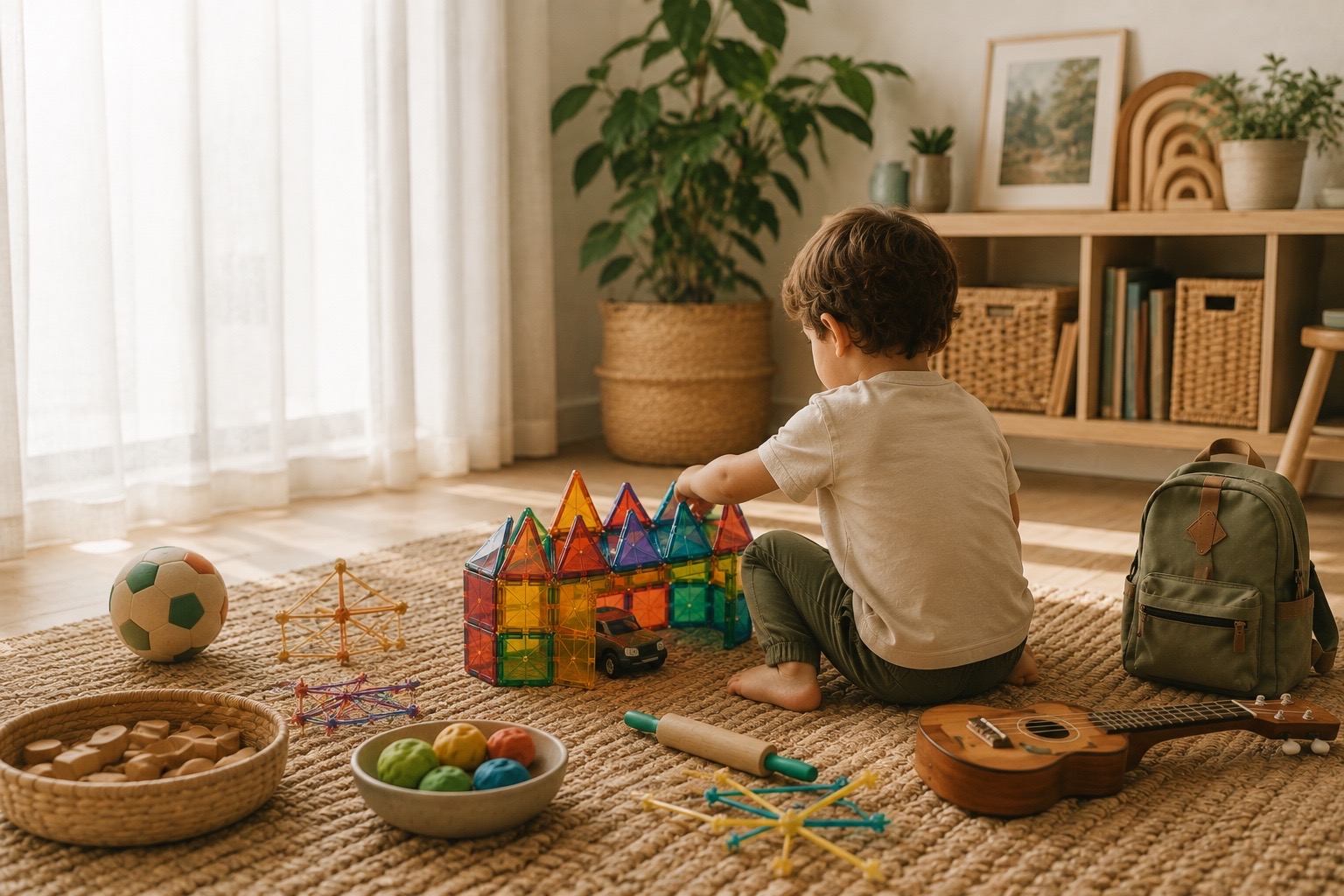
Three-year-olds don’t need a house full of toys to stay entertained.
In fact, in our family, we don’t have a huge collection of toys at home. As a full-time working mum, my children spend much of their weekdays at daycare, and our weekends are often spent out of the house — at parks, visiting family or friends and exploring Adelaide.
That changed when I went on maternity leave with our third baby.
Suddenly, my three-year-old son was spending much more time at home with me, and I realised that a few carefully chosen things could keep him happily occupied for surprisingly long stretches of time.
Most things that have worked best aren’t necessarily the most complicated or expensive toys. They’re things that encourage imaginative play, creativity, coordination, independence and participation in everyday family life.
Here are 10 things my three-year-old genuinely loves playing with — and that I think are worth having around the house.
10 useful things at a glance
| Football or netball | Outdoor play |
| Magnetic tiles | Construction and imagination |
| Straw construction | Creativity |
| Play dough | Imaginative play |
| Yoto Player | Screen-free entertainment |
| Children’s cooking tools | Independence |
| Mixing tools | Baking and family time |
| Learning tower | Kitchen participation |
| Musical instrument | Skill development |
| Backpack | Imaginative play |
1. A football or netball

Why we like it: active play that doesn’t feel like exercise.
One of the simplest things we have found useful is also one of the best: a ball.
At three, children are developing rapidly when it comes to balance, coordination and gross motor skills. Kicking, throwing, catching and chasing a ball gives them an opportunity to practice these skills without it feeling like structured exercise.
For us, the biggest benefit is that it gets everyone outside.
We can take a football or netball to the local park and kick it around. Sometimes it’s an organised game; more often, it’s simply running after the ball, trying to kick it between two imaginary goalposts or throwing it back and forth.
It is a very simple activity, but it gives us a reason to spend time outdoors together — and our three-year-old boy absolutely loves it.
Best for: outdoor play, coordination, gross motor skills and family time.
Find it here: https://link.amazon/B0aGYUz8P
2. Magnetic building blocks
Why we like it: one toy, endless possibilities.
Magnetic construction tiles such as Connetix have become one of our favourite types of toys because they don’t have a single “correct” way to play with them.
One day, my son might build a rocket. The next, he is making a garage for his cars. Another day, the blocks become houses for his soft toys.
This kind of open-ended construction encourages children to experiment with shapes, balance and spatial relationships while also giving their imagination plenty of room to take over.
The important thing for me is that the same set can be used again and again in completely different ways.
You don’t necessarily need the most expensive brand, either. There are plenty of magnetic construction alternatives available (in fact, a set we once found at Aldi worked as well as Connetix and was compatible with our initial set), so you can always choose something that fits your budget.
Best for: imaginative play, construction, spatial awareness and creativity.
Find it here: https://link.amazon/B01NpvNpn
3. Straw construction sets
Why we like it: surprisingly absorbing creative play.
Straw construction toys are another simple idea that can provide a lot of entertainment.
They consist of flexible straws and connectors that children can join together to create different structures and shapes.
At three, my son enjoys experimenting with what he can make — and there is something particularly satisfying about being able to take a creation apart and start again.
Unlike a toy with a predetermined result, these sets encourage children to think:
“What can I make with these?”
That open-ended question is where a lot of the fun comes from.
Best for: creativity, construction, problem-solving and imaginative play.
Find it here: https://link.amazon/B00CHFQib
4. Play dough

Why we like it: you can make absolutely anything.
Play dough is one of those things that seems almost too simple — until you watch a three-year-old get completely absorbed in it.
We’ve made cakes, cars, plates, vegetables, superheroes and all sorts of things that exist in my son’s imagination on the day.
The beauty of play dough is that there is no need to follow instructions. You can give a child a few colours and some basic tools and let them decide what they are making. A piece of play dough can become a birthday cake, food for a teddy bear, a pizza for the family or an entirely invented object.
And when they decide they’re finished, you simply roll it up and start again another day.
Best for: creativity, fine motor skills and imaginative play.
Find it here: https://link.amazon/B04MERRMy
5. A Yoto Player

Why we like it: independent entertainment without a screen.
The Yoto Player has been particularly useful for us because it gives my son something entertaining to do independently without automatically reaching for the television. It’s not cheap, but we found that for us it was the money well spent.
He can choose what he wants to listen to which gives him well needed at this age sense of ownership.
For a three-year-old, I like that it introduces technology in a relatively gentle way. Instead of staring at a screen, he is listening to stories, music and other children’s content while using the player himself.
There is also something quite lovely about seeing a child develop a sense of autonomy around entertainment:
“What do I feel like listening to?”
It has become one of those things he can turn to when he wants to be exposed to digital content but we don’t want to put on TV.
Best for: independent play, listening, stories, music and screen-free digital entertainment.
Find it here: https://link.amazon/B08lQ1yHe
6. Montessori-style children’s cooking tools

Why we like them: letting them actually participate.
If your three-year-old enjoys cooking, this could be one of the best gifts you can buy.
Our son loves helping with dinner, particularly when he is allowed to actually do something rather than simply watch.
Child-friendly cooking tools such as a suitable children’s knife and cutting board allow him to participate in age-appropriate food preparation alongside us.
For us, this turns something that needs to happen anyway, making dinner, into an activity we can do together.
He’s much more interested in vegetables when he has helped prepare them, too.
Of course, cooking with young children requires close adult supervision, and tools should be chosen specifically for their age and abilities.
Best for: independence, practical skills, fine motor skills and family time.
Find it here: https://link.amazon/B00mlWvj5
7. Spatulas, mixing bowls and a whisk

Why we like them: you probably already own everything you need.
You don’t necessarily need to buy a special children’s baking set to make cooking with a three-year-old fun.
Some of our favourite activities involve ordinary kitchen equipment: a mixing bowl, spatula, measuring cups and a whisk.
Pancakes and crepes are particularly good because children can help measure ingredients, pour, stir and mix. And, of course, there is the reward at the end which requires patient waiting – another useful skill to develop for a little person.
The best part?
You probably already have everything you need in your kitchen.
Best for: practical learning, following instructions, measuring and family time.
Find it here: https://link.amazon/B0bs8gK9v
8. A learning tower or sturdy kitchen stool
Why we like it: independence starts with being able to reach.
If your child enjoys helping in the kitchen, a safe way to reach the bench makes an enormous difference.
A suitable learning tower or sturdy kitchen stool allows our son to stand at an appropriate height and participate more fully in cooking and other activities.
Instead of standing on tiptoes or asking to be lifted up every few minutes, he can actually see what we’re doing and contribute.
For our son, the stool has effectively turned the kitchen into another place to learn real life skills while enjoying sensory play.
It also makes activities such as baking, washing vegetables and preparing ingredients much more interactive.
It’s worth noting that the stool requires constant adult supervision. Hot surfaces, sharp objects and the elevated position can all pose safety risks if a child is left unattended.
Best for: independence, practical skills and participating in everyday activities.
Find it here: https://link.amazon/B02GFbV7p
9. An ‘adult’ musical instrument

Why we like it: when curiosity turns into a skill.
If your child has started showing an interest in music, a real musical instrument can be a wonderful gift.
Our son has been particularly interested in guitars, so recently we purchased the Loog guitar for his birthday, which gives him something tangible to explore while building foundations for the guitar playing skill.
Of course, not every three-year-old will want to learn guitar and if they do, it doesn’t have to be the most expensive product on the market.
The broader idea is to follow their interests. If they’re fascinated by drums, piano, singing or another instrument, giving them an age-appropriate way to explore that interest can be much more rewarding than buying another toy that will be forgotten quickly.
Best for: musical exploration, concentration, creativity and developing a new skill.
Find it here: https://au.loogguitars.com/products/loog-mini-kids-guitar
10. A backpack or a sturdy tote bag
Why we like it: a simple object that you likely already have that unlocks imaginative play.
One of the most unexpectedly useful things we’ve identified is a little backpack for my son to pack his belongings.
It becomes whatever he wants it to be.
Sometimes he’s going on a trip. Sometimes he’s going to the park. Sometimes he’s packing for an imaginary adventure.
He chooses what to take, works out what fits and what doesn’t, takes things out and rearranges everything again.
It sounds incredibly simple, because it is, but it encourages imaginative play while also introducing practical concepts such as size, capacity, organisation and making choices.
And because the bag is a real-life object rather than a traditional toy, it is also useful when we’re actually leaving the house.
Best for: imaginative play, independence, organisation and understanding space and capacity.
Find it here: https://link.amazon/B09l0YTLJ
What makes these things different?
None of these activities require a child to sit down and play with a toy in exactly the way the manufacturer intended.
Instead, they give a three-year-old something to do, something to explore or something to participate in.
A ball gets you outside.
Building blocks become a rocket.
Play dough becomes dinner for a teddy bear.
A mixing bowl becomes a baking activity.
A backpack becomes a suitcase for an imaginary adventure.
And a guitar can become the beginning of a genuine musical interest.
For me, that is what makes these things particularly valuable during this stage of childhood.
And you don’t need all of them.
If you’re trying to avoid filling your house too quickly, I wouldn’t rush out and buy all the items on the list, but instead use it as an inspiration for something that might fit in with your life and may appeal to your child.
Some of the most useful things are already in our home — a ball, kitchen utensils, a stool and a backpack. Others, like magnetic tiles or a Yoto Player, are things we’ve found worth investing in because they get used repeatedly.
The best toy is often the one your child keeps coming back too, and it may be something as simple as a ball, a box of play dough or a mixing bowl, something that already exists in your house.
Beautiful things. Useful ideas. Better choices.
Note: This article contains affiliate links. If you purchase something through one of these links, I may receive a small commission at no additional cost to you. I only recommend products and ideas that I believe provide genuine value.
Leave a Reply